
Platform: Working in LunaLift
Knowledge Base
The store of verified facts about your company that powers schema markup and Luna's content.
Updated 28 September 2026
Company Knowledge Base
The complete guide to the Knowledge Base: what it is, why AI search engines care, every entity type and field, and how to set them right. Last updated 25 July 2026.
The Knowledge Base is LunaLift's store of verified facts about your company: your organisation, the people behind it, and the products and services you offer. LunaLift turns these facts into the schema markup published on your website, and Luna treats them as ground truth when she writes content or answers questions.
Why AI search engines care
AI search engines such as ChatGPT, Perplexity and Google's AI results don't rank pages like traditional search engines. Instead, they build an understanding of your business—who you are, what you offer, and whether trusted sources support those claims. When someone asks for a recommendation, AI responds based on that understanding. If your brand information is complete, accurate and well-supported, you're far more likely to be recommended.
The Knowledge Base is where you shape that understanding. The information you provide feeds Luna's content generation, powers the JSON-LD schema markup published on your website, and supports analytics that measure your AI visibility. It also helps search engines qualify your pages for rich results, while ensuring Luna generates accurate, consistent content based on verified business information rather than assumptions.
What you see on the page
Entities are organised into tabs by type: Organization, People, Ideal Customers, Locations, Categories and Offerings. Selecting a row opens the inspector on the right, where every fact can be reviewed and edited in place. Each row shows its priority gaps, freshness (when the fact was last checked) and verification status.
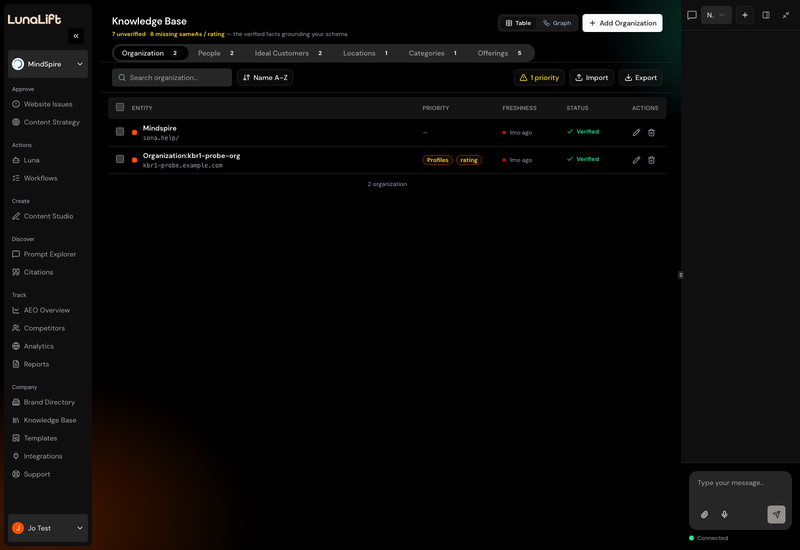
The Graph view shows the same entities as an interactive map of relationships: which offerings belong to which categories, which customer profiles they serve, and where.
The entity types, in depth
Organization
Your company itself: the anchor entity of the whole graph. Every article, product and person LunaLift publishes connects back to it, so weaknesses here weaken everything else. Its fields:
- sameAs (high priority): links to your profiles on platforms AI systems already trust. This is how an engine confirms that the company on your website is the same company on LinkedIn, and that both are real. Add your LinkedIn company page, Crunchbase profile, Wikidata entry if you have one, Google Business Profile, and official registries for your industry, plus your main social profiles. More corroboration is better; every link is another independent witness to your identity.
- url, logo, email, telephone, location: your basic identity and contact card. Set them once, correctly, and keep them identical to what your website and external profiles say. Inconsistent contact data across sources is a classic trust killer, because engines cannot tell which version is true.
- address, openingHours, priceRange (local businesses): fill these if customers visit you physically. Setting any of them upgrades your published type to LocalBusiness, which unlocks local rich results. Google requires name and address for a valid LocalBusiness snippet, and recommends telephone, opening hours and price range.
- aggregateRating (high priority): your overall review score, as a rating value plus a review count. Source it from a real review platform (Google reviews, Trustpilot, G2, Capterra) and keep it current. Never invent a rating: engines cross-check, and a fabricated score that does not exist anywhere else undermines every other fact you publish. Note that Google ignores a company rating that only appears on the company's own site (a "self-serving" rating), so ratings do their heaviest lifting on your products. LunaLift automatically keeps rating markup only where Google accepts it.
People
The humans behind your content: founders, experts, authors. AI systems weigh who wrote something, not just what it says. Content with a real, verifiable author outperforms anonymous content, which is why author and reviewer identity is part of how LunaLift scores your articles.
- sameAs (high priority): the person's LinkedIn profile is the single most valuable link here; add a personal site or speaker profile if one exists. It lets an engine confirm the author is a real practitioner in the field.
- jobTitle and affiliation: state expertise plainly ("Head of Compliance", not "team member"). The title is what makes an author a credible source on a topic.
- Roles: mark people as author, reviewer or approver. Authors and reviewers are published into your article schema, which is how an engine sees that a piece was written and checked by named, qualified people. The expert flag and contact preferences are internal only: they route Luna's questions to the right person and are never published.
Offerings
One entity per product or service you sell. Each offering knows whether it is a product or a service, and LunaLift publishes it with the matching schema type. This is the entity AI shopping and comparison queries run on: "best X under 100", "who offers Y in Germany". If your offerings are incomplete, you are simply absent from those answers.
Fields for every offering:
- name and image (high priority): the two facts Google most wants on a product card. Use the customer-facing product name, not an internal code, and a high-quality image URL.
- sameAs and url: the product's page on your site, plus listings elsewhere (marketplaces, review sites, app stores). Same corroboration logic as the organisation.
- aggregateRating (high priority): product ratings are the strongest snippet signal you can add, and unlike company ratings Google accepts them on your own product pages. Source real values from your review platform. The rating always belongs to the product itself, never to an individual price or variant, and LunaLift enforces that placement automatically.
For products specifically:
- brand and manufacturer: who makes it and under what brand. Connects the product to brand-level trust you have built elsewhere.
- sku and gtin: your internal article number and the global barcode number (EAN/UPC). The GTIN is the strongest product identity signal there is, because it is globally unique: it lets an engine match your product to the exact same item in every other shop, review and price comparison. Find it on the packaging, from your supplier, or in your commerce backend.
For services specifically:
- provider, serviceType, areaServed: who delivers it, what kind of service it is, and where you actually serve customers. areaServed is what gets you into "near me" and "in <country>" answers, so state it honestly and completely.
Prices, availability and variants
Each offering carries its buy-options: the price, currency, availability and inventory level of every way to purchase it. Products that come in configurations (size, colour, material) also carry variants, each with its own SKU, GTIN and image. Google requires price and currency for a valid offer snippet, and a product needs at least one of a price, a rating or a review to be eligible for rich results at all.
Why engines care so much about commercial data: an AI assistant recommending a purchase needs to be confident the product exists, is available, and costs what it says. Stale prices and dead availability are exactly the failures that make an engine drop a source. Fresh commercial data is a competitive advantage precisely because most websites get it wrong.
Ideal Customers, Locations and Categories
These three are business-profile entities: they are not published as schema markup. They exist because Luna needs to know who your content is for, where your market is, and how your offerings group into families. They steer topic selection, wording and analytics.
- Ideal Customers: the personas you sell to. A specific description ("operations lead at a mid-size logistics company, struggling with manual scheduling") lets Luna write in that reader's language and prioritise their questions. Vague personas produce vague content.
- Locations: the markets you serve. These drive geographic targeting in content and in how your AI visibility is measured per market.
- Categories: the product families your offerings belong to. Categories connect offerings to customer profiles in the graph, which is how Luna knows which products matter to which audience.
Link them: customer to category, customer to location, category to offering. The relationships are visible as chips on each entity and as edges in the Graph view, and they are what turns a list of facts into an actual model of your business.
Where the data comes from
LunaLift's website analysis extracts an initial set of facts automatically; they arrive unverified and wait for your approval.
Import and export
Use Import to bulk-load entities into the Knowledge Base, and Export to download the current state, either the full set or just the entities you have selected. Export before large clean-ups so you always have a copy of what was there.
Sync your Shopify store
If you run on Shopify, connect the Shopify integration via the Integrations page and stop maintaining commercial data by hand: live prices, availability and inventory from your shop are layered automatically on top of your offerings, so your published schema follows your store in near real time.
Your manually entered facts remain underneath as a durable fallback, which means your schema stays valid even if the connection is ever paused. Without Shopify, treat prices and availability as facts you update the same day they change in reality.
What is most important to get right
- Verify your facts. Only verified facts become ground truth; nothing unverified ever reaches your schema. Review each tab after onboarding and approve what is correct, individually or in bulk.
- Fill the priority gaps. The priority filter highlights entities missing high-impact fields such as sameAs links or ratings. Filling these strengthens the trust signals in your schema and improves how AI systems connect your brand to external sources. It is the highest-leverage editing on this page.
- Keep one clean entity per real-world thing. Signals split across duplicates always look weaker than one complete entity. Merge duplicates, keeping the best facts from each.
- Keep commercial data current. Prices, availability and offerings must match reality. Connect Shopify if you can; update by hand the day things change if you cannot.
- Update any changes. Whenever products, prices or team change update the affected entities the same week.
- Occasional checks. Open the Graph view and check the relationships still reflect reality.
Common pitfalls
- Leaving facts unverified after onboarding. The analysis of your website stays invisible until you approve it.
- Skipping sameAs links. Without links to profiles AI systems already trust, they cannot corroborate your identity, and uncorroborated brands are risky to recommend.
- Inventing or inflating ratings. A rating that exists nowhere except your own markup is worse than no rating: it contradicts the sources engines cross-check, and damaged trust spreads to every other fact you publish.
- Products without identifiers. Missing GTINs and SKUs leave engines unable to match your product to its reviews and listings elsewhere, so that external reputation never reaches you.
- Duplicate entities, and deleting instead of merging. Duplicates split your signals; deleting one throws away its verified facts. Merging fixes both.
- Set and forget. Facts age. The freshness column shows how long ago each entity was checked; stale prices and outdated offerings erode the trust your schema has built.