

Introduction
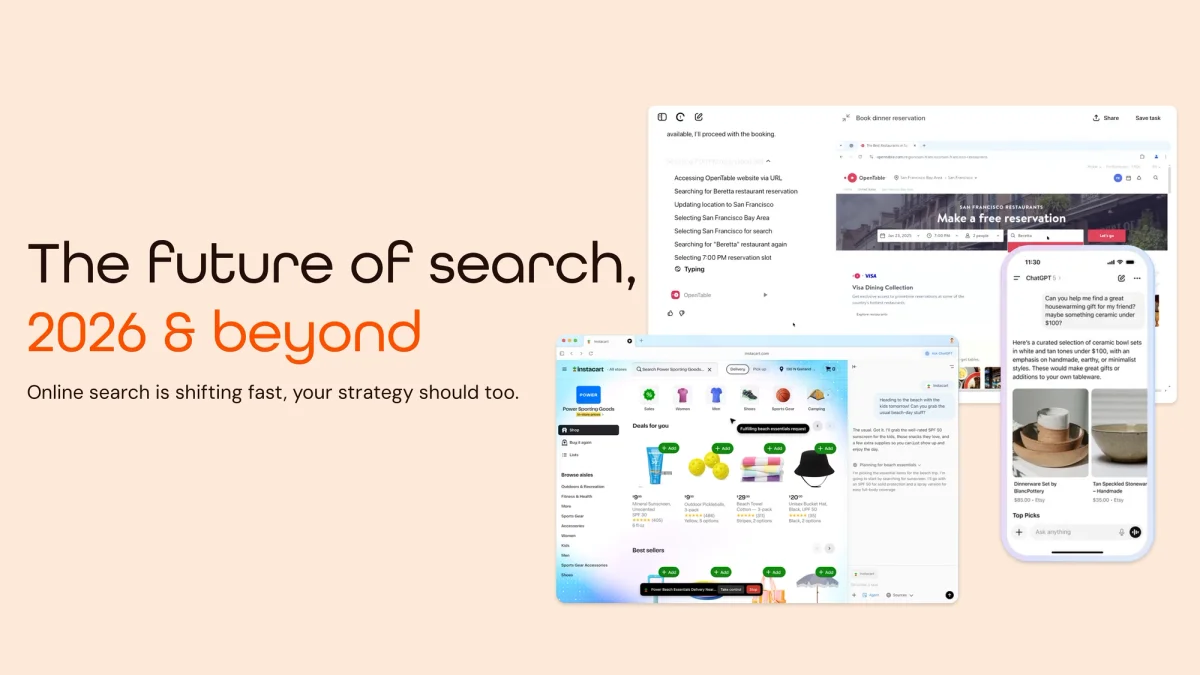
2025 was dubbed “the year that changed online search”. Now, 2026 is solidifying the major changes to brand discovery and moving closer towards a web run by AI agents: search is shifting from “find links” to “complete tasks”.
From the rise of AI browsers to rapid changes in online shopping, we break down the new search KPIs to track and how to adapt.
Read on to find out what’s coming (fast), and what you should be doing about it.
How online search is changing in 2026
Last year, discovering new products and services through LLMs like ChatGPT took off rapidly. Now, the next major shift is already underway: the rise of AI agents and AI-native browsers.
With tools like OpenAI’s Atlas and Perplexity’s Comet, users can move beyond recommendations, asking AI not just what to buy, but to complete tasks and transactions across the web.
Instead of juggling tabs, apps, and extensions, AI browsers consolidate everything into seamless, task-driven workflows.
What does this mean for the future of online search?
Instead of manually searching, clicking through links, and reading multiple pages, AI can now act on your behalf:
– Navigate websites autonomously
– Extract and prioritise key information
– Handle repetitive tasks
– Summarise findings and surface changes
– Track topics over time
– Compare sources
– Retain context across sessions
Traditional browsers like Chrome are built for navigation, whereas tools like Atlas or Comet function more like research assistants. The result is fewer steps, less friction, and faster access to what actually matters.
If zero-click search had a major impact in 2025, this shift in behaviour is set to accelerate even further.
Online shopping has entered its next phase
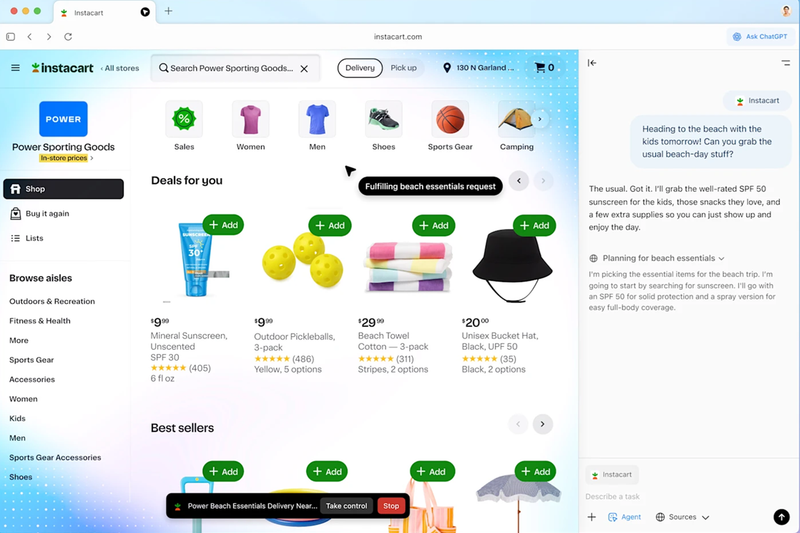
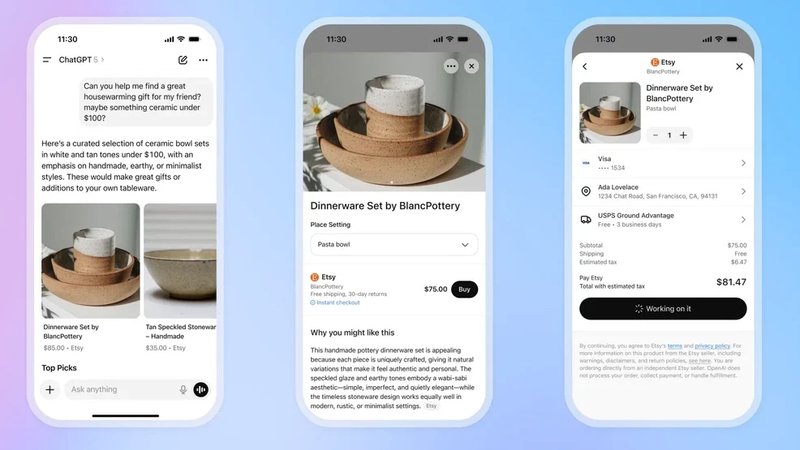
We’re moving into a new era of online shopping where AI doesn’t just recommend products, it acts on the user’s behalf. This shift, often referred to as agentic commerce, turns AI into a personal shopper that can search, compare, decide, and now complete purchases.
Google is accelerating this transition. With updates to AI Mode introducing conversational shopping, users can describe exactly what they’re looking for in natural language. From there, Google’s AI can browse the web, shortlist products, monitor price changes, and guide decisions, behaving more like an informed shopping assistant than a traditional search engine.
In an agent-driven ecosystem, customers may complete purchases without ever visiting your brand’s website.
In addition, Google is expanding transactional capabilities within search. In the U.S., users can already book restaurants directly through AI Mode via partners like OpenTable and Resy, with services and events likely to follow.
Search is rapidly evolving from “find me X” to “find me X and do Y for me.”
For e-commerce businesses, this fundamentally changes how you need to operate.
To remain visible and competitive in this new environment, you need to:
- Ensure your product data is machine-readable and accessible by structuring catalogues with schema markup, clean feeds, and crawlable pages.
- Expose your catalogue via APIs or integrations so agents can access real-time data like pricing, availability, and variants rather than relying on static pages.
- Optimise for entity recognition, not just keywords, by keeping your brand, products, and attributes consistently defined across the web.
- Enable seamless, programmatic checkout by supporting fast, embedded payment methods and API-driven purchase flows that reduce friction for AI-led transactions.
- Integrate with emerging agent ecosystems by connecting to platforms that support in-conversation or agent-led purchasing experiences, such as ChatGPT Merchant.
- Build for attribution beyond clicks by tracking assisted conversions, API activity, and other AI-driven signals to understand performance beyond traditional analytics. You can use LunaLift to track all bot, user and conversion activity (including all AI-attributed traffic & conversions).
If you sell online, the goal is no longer just to attract traffic; it’s to be selected and transacted on, wherever the customer journey takes place.
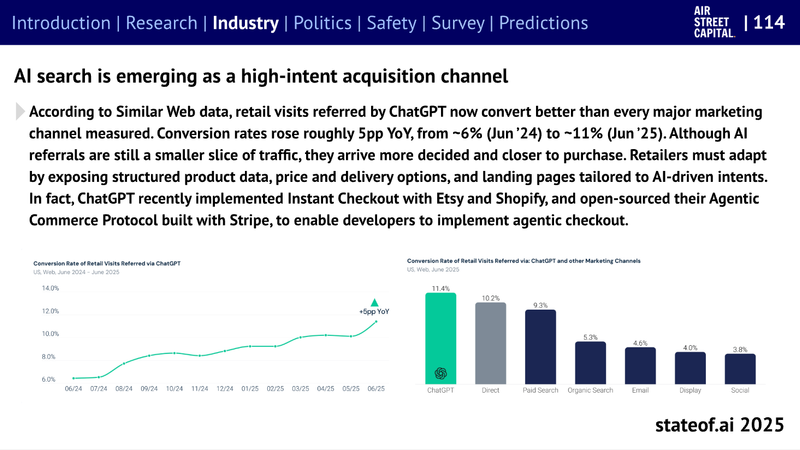
Recent data already points to this shift. Over the past 12 months, traffic from ChatGPT has shown higher conversion rates than many traditional channels, signalling stronger intent and decision readiness.
So what does this all mean for your company’s website?
Most websites are designed for humans, but remain largely unreadable to AI browsers and agents.
As we move toward automated browsing and agent-led actions, the technical structure of your content increasingly determines whether AI systems can:
✅ Understand it
✅ Trust it
✅ Cite it
✅ Use it to take action (book, buy, contact, or sign up)
This is where properly implemented structured data becomes essential.
At LunaLift, we automate the enrichment of structured data across all of your web pages.

How to get ahead & future-proof your website
We know Google-focused SEO tactics are no longer enough, and neither are the old tracking methods built around measuring traffic from one search source.
The new search KPIs to track
AI visibility rate = How often your brand, products and/or services are mentioned or recommended in AI-generated answers.
Sentiment rate = The tone or framing AI uses when describing your brand (positive, neutral, or negative).
Citation frequency = The number of times your website and online content are linked or referenced in AI-generated answers.
AI referral traffic = The number of users that land on your website after being referred from an LLM (directly & indirectly).
AI-Attributed conversions = The rate of conversions that originated via AI-generated answers or citations.
AI health status = How much of your content is accurately and correctly mirrored as structured data (schema.org attributes and markdown) so that machines can quickly and easily retrieve your content without misunderstanding the information.
What every company should do to optimize for the new search KPIs:
✅ Make your content usable & readable to machines > using schema.org & markdown
- The LunaLift integration automates this for you
✅ Focus on content that addresses and solves your customers problems > always think E-E-A-T (experience, expertise, authority & trust)
- See what prompts your ICP are searching for in LunaLift
✅ Track what the LLMs are saying (or missing) about your brand
- Track visibility + sentiment using a tool like LunaLift
✅ Monitor what content types the LLMs are referencing to guide your content roadmap
- Track competitor analytics & receive digital PR opportunities in LunaLift
✅ Track the new search KPIs that matter = AI bot activity & AI attributed traffic + conversions
- Only possible with LunaLift’s tracking, not Google Analytics
In summary
Online search is shifting toward an AI-first model, automated and designed for users who want speed, clarity, and intelligent assistance rather than endless tabs and manual searching.
Browsers like Chrome still dominate, but emerging AI-native browsers such as Atlas are being built for where the web is going, not where it started in 1998.
To stay ahead of both AI-generated search results and the next generation of AI browsers, the simplest way to future-proof your business is through LunaLift. We provide automated insights that traditional SEO tools and agencies can’t yet deliver.
Join the waitlist to receive a demo of LunaLift!