

TL;DR
Schema markup is still critical in 2026, but its purpose has evolved. Rather than just helping search engines rank pages, structured data now helps AI systems like ChatGPT understand, trust, and reference your content.
However, schema alone won't boost visibility - it must be paired with genuinely helpful content that demonstrates expertise and authority.
Best practices include using Article, Person, Organization, and Product schemas alongside clean HTML and a clear site structure. Avoid using schema to exaggerate or mislabel content, as this damages credibility with both AI and traditional search.
For teams struggling with manual implementation, tools like LunaLift can automate schema at scale while ensuring accuracy and consistency across your site.
Introduction
In the age of AI search, many teams have more information than clarity. There’s no shortage of opinions, tools, and ‘best practices - but very little agreement on what actually works.
As companies invest more in optimizing for AI and LLM-driven recommendations, search results remain volatile. It’s unclear which optimizations still matter, or how today’s content decisions will affect visibility in the months ahead. In this shift, content can become invisible not because it’s bad, but because it’s misunderstood.
One foundational practice we know helps is structured data, specifically schema.org markup, embedded under the hood of your website. This article explores how schema has evolved in the age of AI search, and why effective AI optimization is less about chasing tactics and more about making your content legible to machines.
What is schema, and is it still relevant?
Schema is a way of adding structured context to your content so machines can understand what it is, not just what it says.
More formally, schema (or structured data) is a standardized vocabulary, defined by schema.org, that describes things like products, articles, people, organizations, FAQs, and how they relate to each other.
Schema doesn’t change how your page looks to human users, but it adds a machine-readable layer that platforms like Google, and increasingly LLMs like ChatGPT, rely on for interpretation.
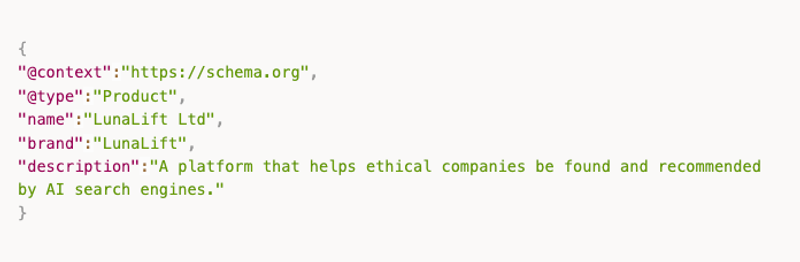
Schema usually lives in your website’s code, most often as JSON-LD added to the page <head> or injected alongside the content. For example, a simplified product schema might look like this:
In traditional SEO, schema’s role was tightly linked to Google: helping crawlers understand pages, qualify for rich results, and improve how content appeared in search listings.
But AI search does not function the same as traditional search engines.
LLMs aren’t trying to rank pages or drive clicks; they’re trying to interpret information, connect entities, and generate answers. That means schema is no longer just about crawlability. It’s about helping AI systems understand what your content represents, how it fits into a broader knowledge graph, and whether it can be trusted enough to reference.
In that sense, schema hasn’t become less relevant in the age of AI, it’s become more foundational. Its value has shifted from visibility mechanics to machine understanding, which is exactly what modern AI search depends on.
“Structured data is like the nutrition label on your content,” explains Sarah B., Lead SEO Consultant at WebFX. “It helps every platform, from Google to ChatGPT, understand what you’re serving.”
Does schema make a difference to search optimization results?
It can, but not by itself.
Schema continues to play an important role in both traditional search and AI-driven discovery. For Google, it helps content qualify for richer SERP features and improves how pages are interpreted. For AI systems, schema provides structure and context, making content easier to understand, retrieve, and reference in search answers.
However, schema does not make up for weak content. AI systems increasingly prioritize original, problem-solving material backed by real expertise — including data, examples, first-hand experience, and credible sources. This is where non-developers have real influence: content that clearly demonstrates expertise, experience, authority, and trust remains one of the strongest drivers of AI visibility.
This also explains a common frustration: why content isn’t picked up despite having schema in place. Structured data doesn’t tell AI systems what to say, it helps them understand what already exists. Schema isn’t a shortcut or magic bullet; it’s a supporting layer that reinforces strong content and connects it into a broader authority ecosystem, linking articles to authors, topics to pages, and companies to trusted external profiles.
What are the schema best practices and tips for technical LLM optimization?
There are hundreds of schema types and properties, many of which go unused simply because developers and marketers aren’t aware they exist or how they influence machine understanding.
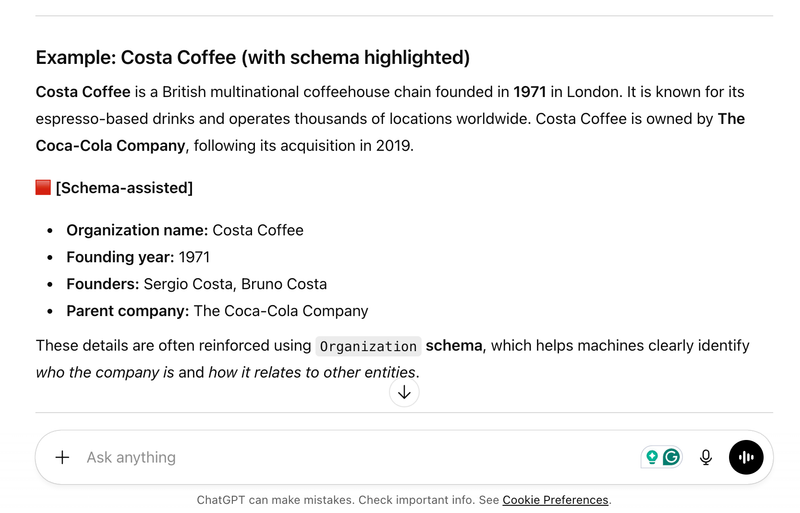
When used well, schema helps reinforce your content as a form of ground truth. It provides explicit signals about entities, relationships, and context, which is especially valuable for Answer Engine Optimization.
Some of the most impactful schema approaches include:
✅ Article, BlogPosting, and FAQ to clearly define informational content
✅ Person and Organization to establish authorship, expertise, and brand authority
✅ Product and Offer to structure commercial intent
✅ SameAs and related attributes to connect your site to trusted third-party profiles and sources
Beyond schema, effective LLM optimization also depends on a few key technical foundations:
☑️ Markdown and clean HTML, which are easier for AI systems to parse than overly complex layouts.
☑️ A clear site navigation with logical page hierarchy and internal linking.
☑️ Supporting files like robots.txt and llms.txt, to allow bots and help define how AI systems should interact with your content.
Altogether, these practices aren’t about chasing search algorithms, but more about reducing ambiguity. Making it easier for AI systems to understand, trust, and retrieve your content when it matters.
What to avoid doing when it comes to schema and optimizing for LLMs
Schema stops being useful the moment it’s treated as a shortcut.
Using structured data to exaggerate claims, mislabel content, or force relevance where it doesn’t exist is one of the fastest ways to have schema ignored, or actively distrusted, by both Google and AI search engines.
For example, marking marketing copy as FAQs, inventing reviews, or assigning authoritative entity types without real supporting content doesn’t boost AI or SERP visibility; it weakens brand credibility.
How to use schema effectively without manual guesswork
As schema becomes more central to both AI and SERP visibility, the challenge for most teams isn’t whether to use it - it’s how to do it accurately, consistently, and at scale.
This is where LunaLift comes in.
LunaLift makes your website fully machine-readable for AI systems, while giving you visibility into how LLMs, bots, and AI-referred users interact with every page. It combines structured data, AI-focused analytics, and actionable optimization - all in one automated workflow.
Schema in action
For one of our LunaLift customers, we take an article that looks like this:
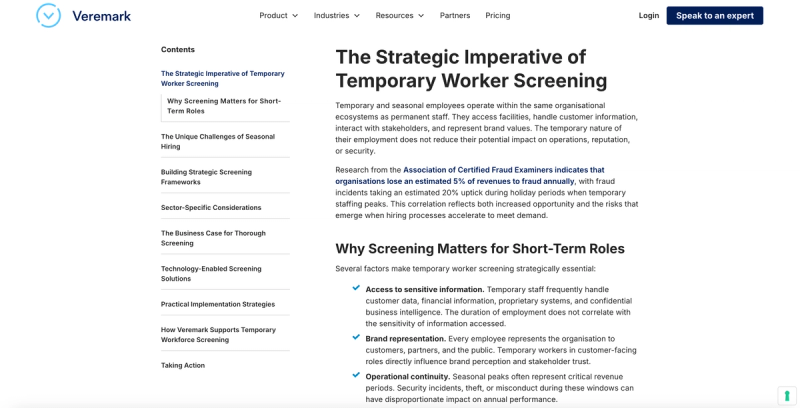
And automatically add best practice schema to translate the content for machines and boost brand authority and trust signals (such as using ‘sameAs’ links):
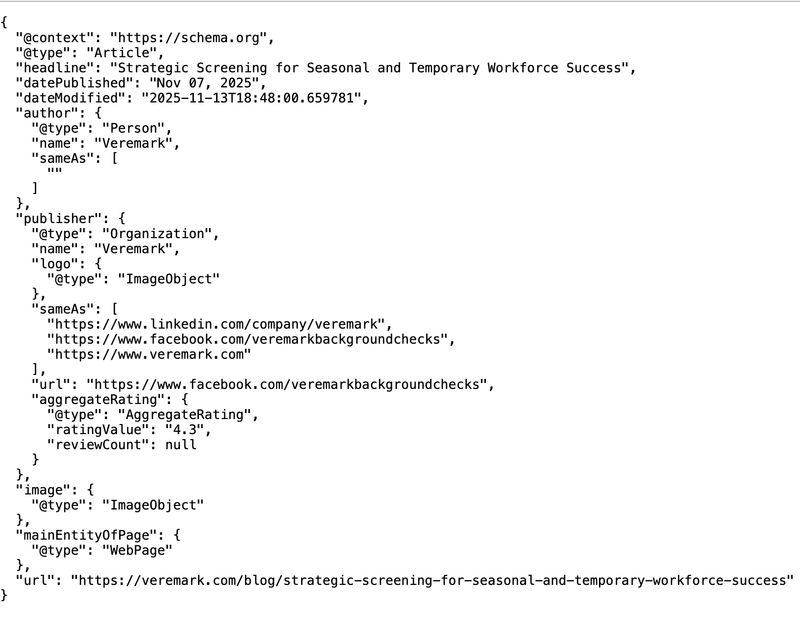
As another example, one of our customers’ websites may say:
“We sell ethically sourced beef boxes delivered across the UK.”
To a human, this is clear and simple. But to an AI, the plain text is vague, unverified and easily ignored.
Our AI would automatically add product schema to the back-end that looks like this:
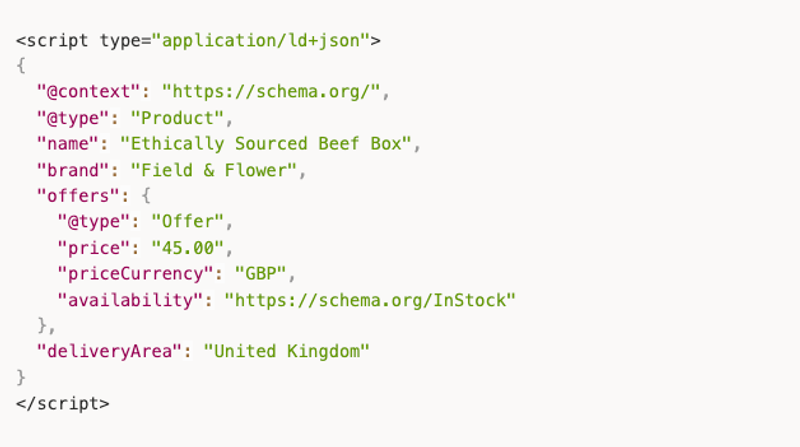
Now an AI agent can:
- Identify the product
- Confirm it’s available
- Know the price
- Know it delivers in the UK
- The company can be recommended when a user asks: ‘Where can I buy ethically sourced meat boxes delivered in the UK?’
Summary
As AI search becomes the primary interface to the web, structured data is no longer optional. It acts as ground truth and can strengthen your broader digital authority. Structured data, schema.org, can reduce misinterpretation, support accurate attribution, and signal to AI that your content is maintained, credible, and trustworthy.
If you want to understand how prepared your website is for AI-driven discovery, request an intro call in the top left corner of this article, and we’ll assess how AI-future-proof your content really is.